Bathroom Mold Removal in Reno, NV
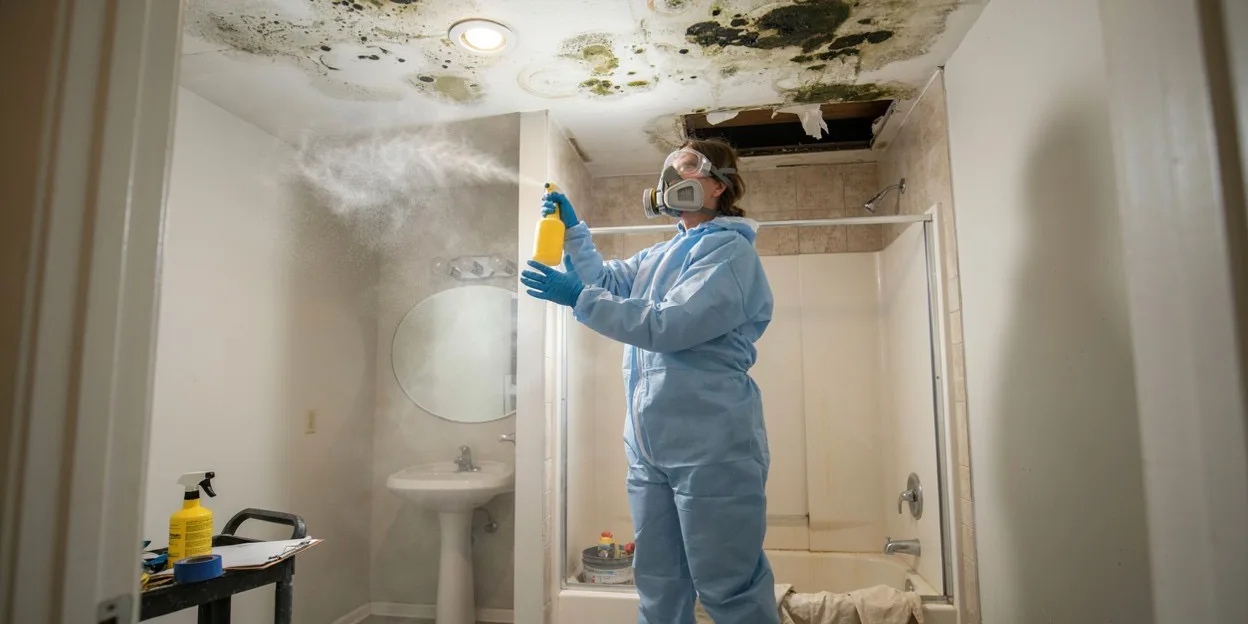
You have wiped the ceiling above the shower three times this year. The spots come back. Now the drywall behind the toilet is soft, the baseboard is swollen, and there is a dark line along the tile where the tub meets the wall. In a two-story tract home this is also the moment you notice the stain on the ceiling in the room below. This site connects you by phone with an independent local provider who does bathroom mold removal in Reno and across Washoe County.
What the crew does first
The crew reads the walls and ceiling with a moisture meter and figures out which of two things is happening. Either the room is not venting steam, or something is leaking. Often it is both. They check the exhaust fan by holding a tissue to it, and in a lot of Reno homes the fan runs but the duct above it ends in the attic, so the steam has been going into the insulation for years. They check the toilet flange, the tub drain, the shower valve, and the supply lines under the vanity.
Then they contain the room. Plastic on the doorway, negative air running, and the register covered. A bathroom is small, so the containment usually covers the whole room and the work moves fast.
What to do in the next hour
Stop using the shower in that bathroom until the crew has been through. Run the fan if it works. Do not spray bleach on the ceiling or the drywall. Bleach wets the paper and does nothing for the growth inside the board, and dripping it onto a wet floor makes the floor wetter.
Look under the vanity and behind the toilet with a flashlight. If you find a drip, shut the valve. If there is a stain on the ceiling below, photograph it. That tells the crew how far the water traveled.
What is usually saved and what is removed
Drywall and ceiling board that read wet come out, along with the baseboard, the insulation behind them, and any particleboard vanity bottom that has swelled. Tile and grout are cleaned. The subfloor around the toilet is the usual surprise: a flange that has leaked for years leaves a soft spot that has to be cut out and replaced during mold damage repair.
After removal the crew HEPA vacuums and wipes the room, then runs drying equipment until the framing reads dry. Fixing the source is part of the job. That might be a new fan ducted to the roof, a rebuilt shower valve, or a new wax ring. If the water went into a crawl space, crawl space mold remediation covers what happens under the floor.
Washoe County notes: fans, freezing, and two-story homes
Bathroom mold in Reno and Sparks has a local twist. Winters are cold and dry, so people take long hot showers, and a bathroom on an exterior wall has a cold surface for that steam to condense on. A fan that vents into the attic instead of outside, which is common in the 1990s and 2000s subdivisions in Spanish Springs, South Meadows, and Northwest Reno, sends that moisture into the insulation. The ceiling above the shower is where it shows up first.
In the older homes in the Old Southwest and Midtown, the bathroom is often on a crawl space, with a cast iron drain and galvanized supply lines that have been in the wall since the 1940s. A leak there runs into the joists below. In the two-story homes across the newer subdivisions, an upstairs bathroom leaks into a downstairs ceiling, and the drywall between the floors is what gets removed.
Nevada does not issue a separate mold license. The plumber who fixes the leak and the contractor who rebuilds the wall are licensed through the state contractors board. Replacing drywall and plumbing in a bathroom usually needs a permit from the City of Reno, the City of Sparks, or Washoe County for unincorporated addresses.
Calling about bathroom mold removal
Have the address and say where the growth is: the ceiling, the wall, behind the toilet, or under the vanity. Say whether the fan vents outside, whether there is a stain in the room below, and whether the house has a crawl space. Call (775) 459-9573.